Friday, April 3, 2020

Week 13: The Main Entree

Cooking is not one of my strong suites. I have been known to successfully burn a grilled cheese every time I cook them but, since the quarantine I have been cooking my family dinner every night.

My sister Christina and I

My sister is definitely more "kitchen oriented" than me. She thinks of everything from each ingredient measured perfectly, what ingredients we need from the store and more importantly the meal itself. Over the past 3 weeks she has taught me a ton about preparing the main meal plus the sides. 

 My sister focuses on the the main course with appetizers (usually a cheese platter), the sides and dessert. I mainly focus on that main meal. I want the chicken parmesan to be perfect and everything else will fall into place. 

Now how does cooking connect to lessons is a valid question you may be asking at this point. When I had 80 minutes with my students everyday I was focused on different activities that all added up to make the students have several take aways from the lesson. Now I am focused on the main parts of the content.

What did I teach?
This week I continued entomology with the Introduction to Agriculture classes by having them watch an insect pinning demonstration by Mr.Serfass, having them investigate insect body parts and common pests.

What did I learn?
With everything being taught online I need to make sure more than ever that my students are getting the big picture. If they are not getting the big picture then I cannot expect them to learn or retain other parts of the content.

What do I mean by this? I cannot expect them to memorize methods of pest control and have them care about pest management if we do not look at the impact it has to an industry that they care about.

This is something that I never thought of till now or at least consciously thought of. Since switching to online I have had to pull the main ideas out of the units and teach that instead of everything I had wanted to do in a unit. I had to be flexible with what was being handed in and as long as the big picture of an assignment was taken away by the student that was a win.

Goals for next week?
Next week we have 2 days of teaching and then spring break. I want to take the days I have for spring break and obtain a Penn State Extension Certification in an area of agriculture that I am not as familiar with to help me grow as a professional.


Friday, March 27, 2020

Week 12: How Do You Build the House?

As a State FFA Officer I had the ability to host some cool workshops. When it came to communication I always used the same activity.
The House without clear directions

I had 2 members facing away from each other. One member was the drawler and one was the master builder. The master builder would describe a house and the drawler would draw the house. 

The directions seemed clear: Draw one line in the center of the page, then draw another line off that one to the right. Then draw a line off that one straight up. Then draw another line to the left. Then draw a triangle over all the lines. Then draw a rectangle in between lines 1 and 3 that you drew. Draw a circle on the new rectangle and boom you have a house! 

Although reading that I am picturing a drawling of a simple house it never came out that way. 

This week I really got to hone in on one of 5 skills we discussed about being an effective teacher. Last semester, we deep dived into 5 principles of effective teaching and clarity was one of them.

What did I teach this week?
This week I started my entomology unit online with 2 sections of Introduction to Agriculture. I used online resources such as Flip Grid, Google Slides and a modified lab to get started with what insects are, insect ID and insect adaptations.
What did I take away?
  • Up until know I was able to answer all questions by a simple hand raise. I tend to forget small details on assignments such as where to hand it in. This week i was able to catch myself a little more doing this because everything has to be electronic.
  • I also had a day or 2 where I had to redo my instruction set because it was not as clear as it could be. Overall, this is a new challenge for everyone because it is easy when i can show students where to find resources and materials before they start but, now I can not do that as easily. 
  • Lessons/assignments with the fewer steps or transferring from several places are the best.

 Goals for this week?

The House with clear directions
  • Have someone in my house read my directions before posting them and see if they can figure out how to do the assignment. This way it adds less confusion on the student end and is someone who has no idea how my class is set up.
  • Host more opportunities for conferences that I can either do a small lesson online at or allow students a chance to ask questions.
  • Sign off more frequently. I have found that since I am now quarantined in my house and teaching from my house I do not really "sign out" of schoology or my email. I have this idea that I need to respond back right away even if it is 7 or 8 at night. I always struggled with work-life balance but, I really now need to come up with a system to sign off for a little bit.


Thursday, March 19, 2020

Week 11: Distance Learning

What is harder than student teaching you ask? Student teaching from 249 miles away, to an online audience when the world looks like it is about to end...

How has Conrad Weiser adapted to schools closing?
With the state mandate to close all public schools for 2 weeks, Conrad Weiser has switched to an online learning platform. We are currently posting materials via Schoology for our students and they have 24 hours to log on and start working. We are taking attendance via the use of a discussion board and holding student accountable through grading assignments.

What does an online lesson look like?
At midnight everyday a new folder unlocks and my students have till 10 am the following day to go on and respond to a discussion board posting to be marked "here" for attendance. I use the discussion board either as a "bellwork" or as the place for students to provide their thoughts on something they read.

Over the past few days I have tried a few things such as students connect CDEs to the class content, a transgenic manipulation simulator and Nearpod. Nearpod seems to be the most successful at this time although there are some glitches at times.

My goal is to keep pushing out the new content while being mindful that the students are essentially now teaching themselves the content.

Ways to improve my online classroom
I normally teach for 80 minutes and have time to achieve 4-5 objectives. Moving online has shortened that to about 1-2 objectives posted a day. The students are now teaching themselves the material and it becomes harder to accomplish all the content we would get done as a class in the virtual environment.

I want to try to incorporate different online sources such as Pear Deck, virtual field trips and FlipGrid to make it more interactive for students to want to engage in the content. I think providing an article/video with a "game" to help reenforce the material is a good way to  sure I am limiting how much content I am putting out but, helping make sure the content gets chunked and started to be place into the long term memory.

Collaborate with other educators. It is important to remember none of us are alone and we all have similar struggles. Using social media, webinars and other resources online to connect with other educators at this time is essential to help better prepare myself to teach online.It is a new and scary environment for all of us but, as a profession will navigate through it.

Thursday, March 12, 2020

Week 10:Calming the Curiosity

When students walk into my classroom I want them to know a few things:

  1. I hear their thoughts and concerns 
  2. I value their opinion
  3. I want them to think outside the box. The sky is the limit.
This week the biggest concern in my students minds was focused around the Coronavirus. That was the first question I was asked at the start of every class, "Do you think we will close?" and "What is going on with the virus?" were two main questions I would get. 

This week I learned really fast how to address their concerns, value their input but, curve their curiosity.

What did I teach?
Intro to Ag playing Journey 2050
Introduction to Agriculture: This week I used Journey 2050, an online farming simulator, to teach about agronomy, international agriculture and sustainability. We would start class by discussing a topic such as plant nutrients. Then we would play the level on the simulator that coordinated with the topic (there was 5 levels) and then we compared the countries the simulator highlighted. The simulator allowed them to farm in Kenya, India and Canada. After discussing the countries we would connect it back to their lives in Berks County, PA.

Current Topics in Agriculture: This week I wrapped up the vet science unit by doing fecal exams, parasite ID, suturing and horse evaluation. The class did a review using Kahoot! and Gimkit to study for their exam that was Friday. I had the exam set up identical to the vet science contest, minus the team event.

Parliamentary Procedure CDE: Over the past few weeks I have been coaching a Parliamentary Procedure CDE team. This week we deep dived into motions and started doing mock meetings.

Viewing a fecal exam for parasites
What did I learn?
What I learned this week was not direct take aways from the lessons I taught. The best practices I learned this week was from other things happening in the world that affected my classroom.


  1. Be honest: I found that instead of not answering questions it was better to be honest with the information I had. Rumors were flying around the building and it eased their minds that I was reading emails directly from administration (with Mr.Serfass present for questions). This was the students knew what to expect and were never blind sided.
  2. Empathy: I always knew teachers needed to be empathetic but, this was a good situation to exercise this. Instead of shutting down conversations I let them ask questions and realized that they have never lived through something like this (neither have I) but, I am an adult that they can trust and I should be understanding of their fears and emotions on the situation. I shared with my class that they are not alone as I fear for my parents who have poor immune systems back home. This allowed them to realize it is okay to be worried.
  3. Not all the lessons I will teach will relate to agriculture: I have always heard that as a teacher you teach other skills that are not necessarily academic. This week was one of those weeks. As rumors progressed it was a great time to discuss reliable sources and social media etiquette. We talked about not sharing screenshots of text messages that we are unsure are true on social media, how to get the most up to date information and what was going on when Pa called a "state of emergency." Overall, the conversations were short but, helped teach the students about what was going on in their lives and our world. 
Goals for next week:

Continuous versus non continuous sutures
 

  1. Clarity: I foresee us not having in person classes next week and need to provide clear instructions for online learning to occur. I have laid out lessons that I can do in person or online already and look forwards to implementing either.


Monday, March 9, 2020

SAE Fridays: An Inside Look

Image result for SAE ag ed
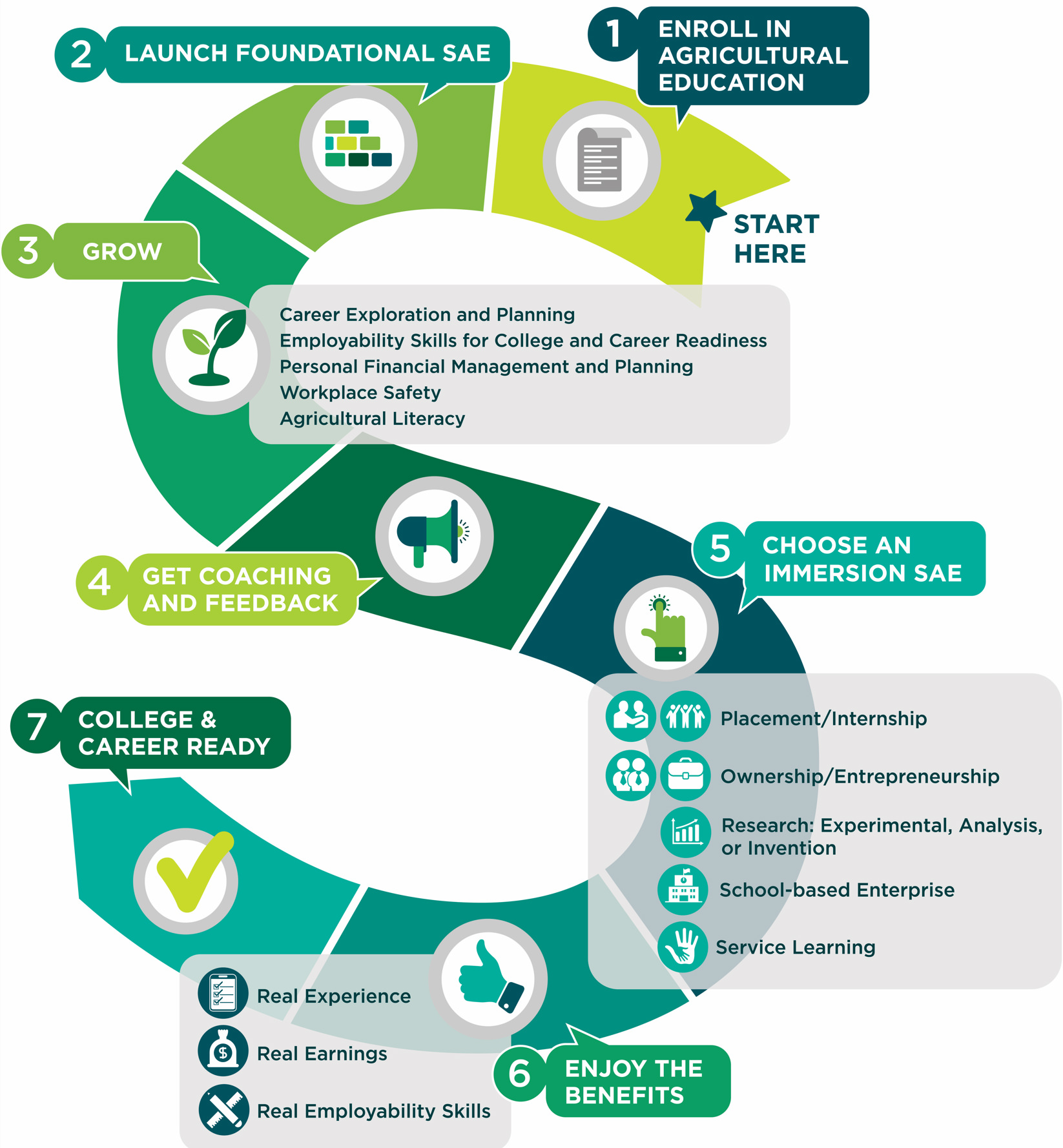
The pathway for SAE for All

Agricultural Experience (SAE) is an essential part of student success in my agricultural program. I have students working on a large range of projects that are helping them connect agriculture content and essential workplace skills. Some students are conducting research using the wet/dry lab, animal rooms and greenhouse, some students are working at home or with a business with animals or plants and some are looking to start their own business.

SAEs are student lead and teacher managed project that helps connect my class to possible careers. Since several of my students have their projects at school, I give them one day a week to work on their projects. While the students are working, I walk around and meet with them one on one.

How does my class look on SAE Fridays?
On Fridays I split the class by doing a review of what we talked about this week, usually a Kahoot! or Gimkit, and then we break out to work on SAE projects. My students really value the time they have to work with their projects. I allow students to work in any part of the agriculture department. As they are working I filter through the rooms and meet with students individually.

The Meeting
As students are working I go around and meet one on one with them. I am mainly seeing where they are at in terms or research or progress since the last time and how I can help.

This looks different for each student. I have 3 students tearing down small gas engines. For these students I might spend some time helping them ID parts and function of those parts. For some students doing research in the lab I might see what materials they need from me and what their procedure is. I have several students still exploring a topic they want to dive into with agriculture so, I might ask them what they read this week and how it relates to their career goals.

Image result for SAE ag ed
The 3-Circle Model of Agricultural Education
Keeping students on task
Everyone is at a different stage of their project. Some research is on hold while others are in their prime of their experiment. It is important to keep everyone engaged during this time we are working on SAE.

I currently have a class assignment where students are reading a scientific journal of their choosing and summarizing the methods and results from that research. Ideally this article would connect to their SAE. If they are at a pause in their research then I allow them to work on the journal for this week.
 I also want to start incorporating some ideas of the SAE for All guide in the foundational SAE stages that I saw while at the NAAE Conference. This included having students do mock interviews, apply for jobs and work on resume/cover letters.

My SAE Vision
SAE is an essential part of agriculture education. I use this piece to have students learn valuable skills needed for the workplace. They keep records that are graded on the Agriculture Experience Tracker (AET) website. They have written a report on their project as part of a professional skills unit to show how what they are doing can connect to a possible career. I see SAE as a way for me to connect students to the world outside of the walls of my agriculture department although most of the research and projects occur in my agricultural department.

I have found that I can be very hands off with students and their projects. If I let them become curious, they amaze me. The students come up with amazing ideas for their project and it is important for me to show them how they can achieve that goal. Not every project idea is possible but, if they can think of it then I want to see how we can get as close to their idea as possible.


Thursday, March 5, 2020

Week 9: Building the Village

The common phrase I hear as a parent is, "it takes a village to raise a child." This statement is one of the only phrases that actually makes sense to me when raising kids. My step daughter is lucky to have 4 parents who love her plus all of our family in her village to help her be successful.

In a school it takes several teacher and departments to come together for the students to be successful. This week I got to see this idea laid out in my building and class perfectly!
What did I teach?
Mini THON '20
 Introduction to Agriculture: This week we wrapped up plant science and moved into the agronomy unit. So far we have looked at what agronomy is, what crops are grown in the North East and what sustainable agriculture is using Journey 2050.


Current Topics in Agriculture: This week we continued our vet science unit by looking at medications, meeting our new pigs and having an artificial insemination demo/practice from a local company, Select Sires.

Mini THON
Being involved in clubs/organizations at the High School I teach at is important to me and to my students. I decided to be a chaperon for the Conrad Weiser Mini THON. I spent from 12 am to 6 am on my feet with several students in my classes. I played volleyball, colored pictures, played corn hole and kept several tired freshman awake till the end. Our school raised over $26,000 for Penn State's THON.

What did I learn?
It takes a village: Teachers cannot be separated into departments in the building. We are all seeing the same students so, we need to work together to enhance their experience in school.

What do I mean by this? I mean is that the students in my class do not only take agriculture. They take science, math and english classes too so, I need to connect with those teachers to get to know the students better/build a support system for the students.

For me, I did this through going to Mini THON and as a group we rallied around the students when they were tired and sore.

Suturing bananas in Current Topics
Incorporate others into your program: My program is not the 7 rooms of my agriculture department at Conrad Weiser. My program includes other departments in and out of the school.

The cafeteria staff is saving food scraps for my two agriculture teaching assistants to feed to the pigs. This gave me a great outlet to talk about food waste in our country, pig nutrition and solved the issue of buying pig feed. When we went to the elementary schools for FFA Week we brought students from the photograph and film classes with us to get hands on
experience recording an event.

We all need to work together to find outlets for our students to connect their passions in the building to other things going on. The students who came with us to the elementary school were not students in my class currently but, students Mr.Serfass thought should have the opportunity to gets hands on experience with their passion of videography. We became their client and they were filming for our event. We ended up getting a promotional video and they got practice working for a client.

Pairing with local businesses: I am not an expert by any means in all things agriculture. That would be impossible. It is important to know when you should step back and invite someone into your class to assist you in teaching something. I invited a representative from Select Sires into my class to demonstrate (and allow students to perform) artificial insemination on a dairy reproduction track. The students were engaged, asking questions about careers and gained so much more than I could have given them. Finding these opportunities increases the quality of my class from time to time.

Goals for next week?
1. Increase student engagement- This week I will be using popsicle sticks to choose students to answer questions. I feel at times I am always calling on the same students and hope if I start randomly selecting students it will increase participation at times.

2. Create stronger interest approaches- Sometimes my interest approaches are not as catching as I would like. I have looked for some resources to help assist me with this!

Questions:
Artificial Insemination with Select Sires
1. How are some way you alert students they are in jeopardy of failing the marking period that will motivate them to either do better next time or submit missing assignments?

2. How do you hold students accountable for their FFA CDE team practices?
I know our students have a ton going on and are split in several different places but, I am struggling to have students attend a practice for a contest that is a week and a half away.

3. How do you set up your lessons for a whole week you will be out? What do you have them working on? Is this a good place for a unit project/FFA exploration?

I am at a point where I have written sub plans several times now, but never for a whole week. My self and Mr.Serfass will be out for 3 days in the upcoming weeks. The only 2 days he will be there has a half day schedule so, we won't be even seeing all the classes.

Friday, February 28, 2020

Week 8: Lions, and Tigers, and Bears Oh My!

When Dorthy from The Wizard of OZ started walking down the yellow brick road she had no idea about the adventure she would have along the way. She encountered new people, went to a new place, and made discoveries about herself and others along the way.

In a way week 8 has been a similar experience for me! I was able to go on adventures with my students for FFA week, meet other teachers/ members of the agricultural industry and learn about myself/ my classes along the way. 

What did I teach this week?
Introduction to Agriculture: This week I tried out using Nearpod and Pear Deck to help engage students in my lectures. I found that my students really enjoyed Nearpod when doing parts of a cell. It helped engage them into the lesson and keep a "dry" subject interesting.

Guinea Pig autopsy with Current Topics in Ag
Current Topics in Agriculture: This week we had some sick Guinea pigs and one had passed. I used this as an opportunity to teach how to do a vet check/physical exam on the 2 still alive and how to preform an autopsy on the one that passed. We followed up the week by learning about using blood to spot illness and how to preform injections.

National FFA Week
This week was National FFA. Week which meant early mornings and late nights! We started this week off by attending a Reading Royals Hockey game and finished with a FFA Breakfast Friday. In between was filled with trips to the elementary school to educate them on the dairy industry and LDEs.

What did I learn?
Stand back and let the kids learn: This week I really tried to be hands off and let the students learn by doing and researching. I used the problem solving approach three different times this week and I struggled to sit back and let them take charge but, it was needed.

It is okay to change your plans to better the students: I changed my week to fit the needs of the students or the block. I changed the day we had the incident with the guinea pigs to provide a real life skill for the students. I adapted the week to help students with their LDEs or CDEs to allow for some class time to discuss these topics or to have time to teach these aspects. It was great to see the students engaging in content that they cared about.

FFA Week takes a ton of planning. This week ideally is planned by officers or at least I had thought so when I was in FFA but, it takes a ton of work on the teachers side. Sometimes it is hard to meet as an officer team so, I might have to pick the theme of what we teach to the elementary school or create ideas for the menu for the breakfast. I am the one who has tried things. I can give the officers options and ideas without picking it for them but, providing that guidance is important.

     Goals for next week
Teaching injections to Current Topics
I want to really focus on balancing that home/work life: Currently I go to school, come home and do work and then go to bed. My weekends revolve around school as well.

Think Time: I need to give more time for students to process my question before accepting an answer

Dealing with disruptive students in a class: How to properly discipline students in real time instead of after the fact. I cannot be afraid to have what we call the "Dutch Uncle" talk with them.


Questions?
1. How do you balance your home and work life?
2. How do you let students work on things but, check in on them without letting them feel like you are right next to them? I want to give my students time to process and attempt projects and activities but, sometimes feel like I am too much over their shoulder.
3. What system do you have for students who are not submitting work? What is your grading policy?