Tuesday, September 3, 2019

Plan Smarter;Not Harder: Lesson Planning 101

Bylaws are a set of rules adopted by an organization to help their organization run smoothly and to keep them on track. Every profession ,including education, have some sort of "rules" that they adopt to help their profession function. 

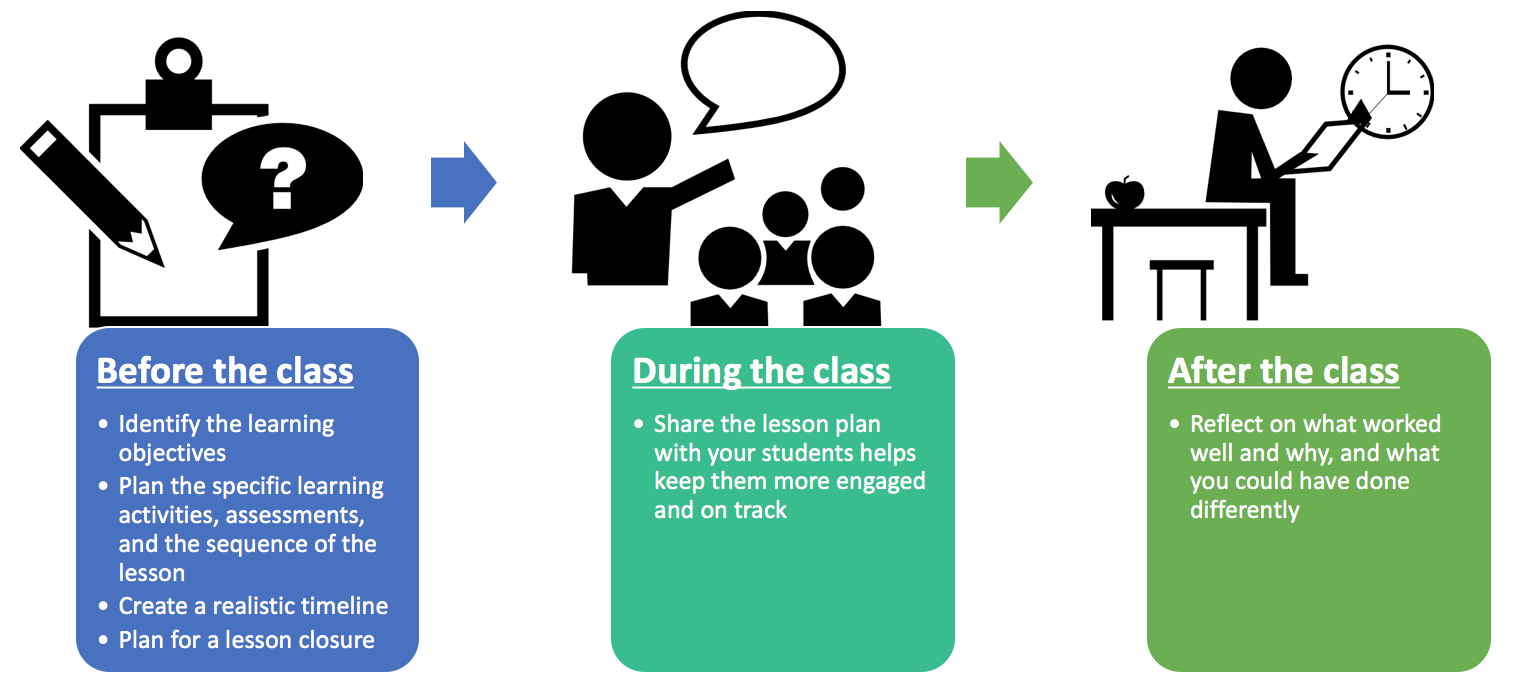
The guide in education isn't a document with a bunch of sections on "how to do x,y and z" but, a lesson plan to provide structure to our classrooms and determine how to teach the content. 

This week we will deep dive into what makes a solid and functioning lesson plan and how they can help me be a better educator. The reading this week helped me create the following connections between where I will be student teaching and classes I have taken as to why I need a plan when I walk into my classroom and why winging it isn't an option.

3 Connections to Conrad Weiser Area High School: 

  1. Asking thoughtful questions is not easy, but necessary to help engage students and to check for understanding. Most of these questions get planned ahead of time and are written in a lesson plan.
  2. When I am panning a lesson I will add content that I need to go over on the lesson plan. There is more than just outlining the "how" of what I am teaching on this document. It should be here is what and how i am going to teach. 
  3. Predicting answers of students ahead of time is key to keep yourself in line with what your students will say and how deep into a subject you can get. 
2 Connections to previous classes at Penn State:
  1. In my Edthp class we discussed a lot about keeping in mind students backgrounds. Not every student has the same home life and this is something I always considered but, never thought how it would effect how I design my lesson.
  2. I also noticed a connection to Kolb's Experimental Learning Theory. The idea of where we start a lesson and how to introduce the topic to your students is a key aspect of structuring a lesson. This connects to Kolb's because you can start the students with an experience first to engage them or physically do a task and then learn about the content that goes with it. This is all designed by the teacher and it comes back to your lesson plan and how we design our lessons based off several . 
After reading about lesson planning I found an article by Edutopia about asking thoughtful questions. This article recaps why as teachers we ask questions to our class and how to do it respectfully to a class.The Right Way to Ask Questions


Saturday, August 31, 2019

What Does Effective Teaching Look Like?

Teaching is more than sharing information from one person to another because if it was that simple then everyone would be a teacher. Teaching is about sharing that information in a way that is effective and connective to your students. After looking at the tip of the ice berg on effective teaching and how we decide what and how to teach I have thought of questions for the following people.
1. For my future students:
What motivated you to take my class and what will keep you motivated throughout the year? (i.e clear expectations, content, hands on activities)

2. For y cooperating teacher: 
What are some ways to get to know your students starting on that first day of school?


3. For my mentor team or cohort: 
What do you believe is the most important part of organizing subject matter? (i.e "The Why", clarity, sequencing or structure) 

Looking at effective teaching from several points of view helps create that need to keep learning how to be purposeful in what i am teaching and how I am teaching the content. This will be a concept that I look at over the next few weeks before I enter a classroom as well as the next few years as I start my career.  

Thursday, August 29, 2019

Plan The Ride;Ride The Plan: Reflecting on Central American Mottos Lesson

“Good Morning class, today we are going to learn about Central American countries and their mottos” is what ever class loves to hear at 8 am on a Wednesday. We started the lesson with a bell work to think about what countries were in Central America before getting up and finding the counties written on note cards around the room. We ended the lesson with creating passports of the counties and their mottos.

This engagement activity would have been a great activity to do if, I slowed down and made sure I had everything I needed before the lesson. For example, I only placed 6 of the 7 note cards around the room and completely lost Honduras. I also kept misplacing my answer key to the passport. Keeping this a tad bit more organized would have saved me so much trouble.

I also learned why a good lesson plan is important. I didn’t put any content in my lesson plan just the activities. If the countries and their mottos were in my lesson plan I could have had everything in one place instead of on 3 different pages. Having a weak lesson plan is like showing up to the horse show and knowing the jumping course but, my horse is at home. I know what I’m doing and how to do it but, I can’t do it. 

I am excited to continue to grow this semester in order to be the best educator that I can be. Reflecting back on each lesson will be a good way to track progress, grow and learn the art of teaching.

Friday, May 10, 2019

LEAD2BigSky Day 5: Connecting Industry and the Classroom

Today, we began our fifth day in Montana at the Great Falls Development Authority. The focus of the morning was to connect industry to the classroom. We spoke with Barnett Sporkin-Morrison, the director of Food and Ag Development Center. Barnett discussed his experiences working for UDSA and USAID. He provided insight to us about how connections to government agencies and entities can impact students interests. Our second speaker for the morning was Mark Black from Malteurop. He spoke about barley processing in Montana. As pre-service teaching candidates, it was interesting to hear about a section of agriculture not common in Pennsylvania. Malteurop has 23 locations, which would be an excellent opportunity for students interested in international and domestic internships.

Our second stop for the day was to Broadwater High School where we met Jemma Loughery. She spoke with us about work-life balance, the importance of perfecting a few classes at a time, and using grants to grow a program. We were given a tour of the agriculture facilities by a student. He showed us the metal shop, wood shop, chickens, composting area, and garden space. Mrs. Loughery emphasized the importance of making connections in the community and placing students with experts for SAE projects.

In the evening, we met with students majoring in Agricultural Sciences and Extension Education at Montana State University. We had a great time eating hamburgers, line dancing and conversing with the Montana State University faculty. One of the students shared how he was involved with the Young Farmers and Ranchers Club and has written legislation to forgive loans for students returning to the                                                                                 farm or ranch after college.

Food for thought: What federal, state, or local organizations could be used as a resource in the classroom?


Nicole Guise & Alyssa Landis

Tuesday, May 7, 2019

LEAD2BigSky Day 2: Diversity in Agriculture Education

LEAD Society at Penn State started off by jumping into learning about wildfires and the smokejumpers. There are 400 smokejumpers who jump into wild fires in the nation. At the base in Montana they have about 50 jumpers and 3 of them are woman! These jumpers get to jump out of the plane into the fire with about 80 lbs worth of gear on top of their suits and then get more supplies sent down to them! It is a hard industry to work in.

We came off that adrenaline rush and into our element when we visited Missula,Mt and their agricultural center. This high school just got a USDA certified meat processing lab. Urban students get to raise beef, lambs and hogs from insemination to table on site. Students own the animals and are responsible for its well being. The meat processing plant is a great fundraiser for the students to make money off of their SAE projects at the end!

The last stop was to an Indian reservation. We met with faculty from Salish Kootenai College were we got to see how art, agriculture and culture can be combined. We started by talking about the research being done on the reservation about an invasive grass that is threatening the bison heard. From there we went on campus and got to make mini drums from deer hid. This was taught to us by an art professor at the college. This was a full circle idea of how the Indians are mindful about using the full animal in their lives.


Food For Thought:
What are some unique aspects of your high school?
What would you like to see so far from our trip implemented in Pa?
How can we diversify our programs to learn more about other states agriculture better?


Thursday, April 11, 2019

All Eyes on LEAD Society: Ag Day 2019!

If State College, Pa all of a sudden has a spike in potato plants it was definitely because of LEAD Society at Penn State planting potatoes with students at Ag Day 2019. 
Ag Day is a day to get students from other colleges to check out what we do in the college of agriculture. Clubs and organizations set up booths with interactive activities to help advocate for agriculture. The well know ones are free ice cream from the College of Agriculture, free plants in a cup from the Horticulture Club and the baby farm animals sponsored by several clubs. 

This year I was able to play a role by helping with the LEAD (Literacy, education and Agriculture Development) Society at their booth. Throughout the whole day I got to interact with a bunch of students with a wide range of knowledge of agriculture. Our booth was known as the potato booth! We helped 183 students plant potatoes using the eyes of the potatoes. 

Many students did not know what the eyes of the potatoes were never mind how to grow them. I explained to them what the eyes were and that potatoes were root vegetables meaning they grew very deep underground. Students found it very interesting that a potato farmer had to dig to find their harvest. 

This day was key to helping me grow as an educator. I had to make connections to these students who knew nothing about potatoes besides they are good with sour cream and bacon on them in order to teach them about the process of growing this crop. Many students were deeply interested in their potato plant. I even had a student ask if he can take his plant on a plane back home! 

This experienced showed me that people generally care about agriculture but, do not always take the time to learn about it or know where to go to learn about it. My goal as an educator is to have my students help others in the community learn about agriculture. It is better to learn from peer to peer than me preaching about it. Ag Day is unique in that aspect of it is students teaching students so the non agriculture students are more willing to come and see what we are all about! 

Thursday, April 4, 2019

Connecting the dots: The difference between Connecticut and Pennsylvania Agricultural Education!

It is 386 miles from where my house in Bristol, CT to State College,Pa. Although it is only two states over the agriculture industries are very different. These two states don't only vary in the agricultural industry but, in Career and Technical Education (CTE) as well! 

The small state on Connecticut has 19 current agricultural high school programs and one currently being built. These schools take applications from designated towns to help fill their program. Students from the town the agricultural program is still needs to apply and has the potential to not be accepted. Once the student applies, interviews at the school and gets accepted they will then be apart of that new towns district. 

The student then takes agriscience classes as well as their general education classes for all four years at that new school. Some schools have tracks for students to follow and some allow students to pick their own tracks and mix and match their classes. Connecticut ,unlike Pennsylvania, is not an affiliated state with the FFA so, membership is dependent on the chapter and student. Currently there are about 3,200 FFA members which means we have more students in agricultural education that that since the state isn't affiliated.

What I find to be very unique in Connecticut is the number of agriculture teachers in Connecticut. Connecticut has 144 teachers (including 18 supporting staff ie. Secretaries and para educators) working at 20 schools. Each school has about 4-5 teachers minimum. This allows teachers to teach specific fields such as veterinary science, plant science, aquaculture and so much more. Each teacher in Connecticut will be hired( most of the time) to teach within an area of agriculture instead of general agriculture.This allows for huge diversity in agricultural programs in Connecticut. 

Connecticut has some unique features to their agricultural education system that makes the small state be able to offer a wide range of opportunities in agriculture to their students. The differences between the state vary in the structure of their programs and amount of teachers per program. 

What are some unique traits of your states agriculture industry and agricultural education system?