Tuesday, August 25, 2020

Summer 2020 Reflection: How Did Being a Greenhouse Operator Prepare Me For My Future Classroom?

 This summer was by far the weirdest one that I can remember. I usually have a plan before I move home to Connecticut from Pennsylvania of where I am going to work. I have held some interesting summer jobs with some of my favorites being a Lifeguard Instructor for the amusement park in my hometown and teaching horseback riding lessons to "high risk" children. 

This year was very different since many places were not open due to COVID and I came home earlier than I thought. I was blessed to be able to find an internship that pushed me out of my comfort zone of the lake and the farm that ultimately gave me the opportunity to become a better educator in the process. 

Where was my internship?

 I was blessed to find an internship with Moscarillo's Garden Shoppe in Torrington,Ct. This nursery has 4 large greenhouses 2 tropical greenhouses, an outdoor nursery, a floral design shop and a gift store. We grow mostly everything on site in the maternity greenhouse and then push the plants out into the main floor for sale. We also have a sister store in West Hartford,Ct that is quit larger. 

What did my day look like?

The cliental this summer was mainly our New Yorkers looking to change up their landscapes at their Connecticut residency for the summer. I usually met with customers to help them design their landscapes with a variety of plants including trees, shrubs, perennial grasses/flowers and annuals. Most of the time my clients had no idea what they wanted or what plants would even grow well in the environments that they had. It was my job to educate them on certain plants and then help them design a beautiful area for their home. 

I also worked behind the scenes watering, pruning, organizing the sale floor,

The main sale floor at Moscarillo's Torrington
overall caring for the plant as well as propagating plants for next year.. I learned about about wrapping trees in the storms to keep them safe from the wind and which plants needed more water than others. I also assisted with making flower arrangements and dish gardens for orders. 

How does this experience connect to agriculture education?

This experience reiterated that not everything I teach has to be done in the 4 walls of a classroom. Every day I was working with clients to teach them something new and none of that occurred in a classroom. I would not just recommend a plant or a fertilizer to someone, I would explain the why behind they should be using something over the other. I had 15 soils to pick from at some point so, the why I was suggesting one over the other I felt was important to the customer and for us as a business to share. Being able to clearly communicate the science behind what was happening to the plant and in the greenhouse is something I will miss doing as part of this internship. 

I also had a very basic knowledge of plant science before starting this internship. I wanted to learn more about greenhouse production. After this summer, I can now recognize different trees, flowers and shrubs, compare different types of soils, preform a soil test, and so much more. I gain a ton of valuable content knowledge. I look forwards to continuing my internship through the winter as we prepare to fill the greenhouse with mums, poinsettias and Christmas trees/wreaths! 


Wednesday, April 22, 2020

Week 16: Goodbye to Conrad Weiser

When you are the first in your family to graduate high school entering college becomes a tad bit scarier than for some. You have to navigate everything on your own and never see the finish line because no one showed you that you can. So, when I embarked on my #TeachAg Journey so many years ago I never pictured the part where I actually student teach. Everything was classes, facilitating workshops, and theory. I never saw the part where I got to apply all the stuff I learned over the past 5 years in a classroom with real students but, here I am another semester later and I have completed my student teaching internship. 

When I started at Conrad Weiser in January I could not imagine all the valuable skills I would learn by the end of the semester. From working with students, planning assignments, how the school and district work, planning events and the list goes on I gained more than I could imagine.Everyone was right to say "trust the process" you learn more in the field.

My Big 3

Conrad Weiser FFA Jacket 
1. Be flexible: Just like us, students have a ton of things going on in their lives. Bending to a certain degree is really important. If I cannot show my students I am flexible then how can I expect them to be flexible with me? Flexibility also comes into play with other teachers, events and other activities in the school. I should want the students to be engaged with other activities of the school and encourage that instead of being a stickler on some work because they might be away. 

2. Engage with others: My program might be me as the sole agricultural teacher. I cannot do everything and need to be able to work with others in the building. In addition, I am not the only teacher my students interact with on a daily basis. It is better for everyone if I work with other teachers in the building to provide the best support to students. Colleagues in the building provide assistance in my class, to my students and working with them provides a great sense of community in the building. I should try at least once a year to co teacher with another teacher in the building. I saw while student teaching how Mr.Serfass connected the photography students into a FFA event we did to give them experience of filming an event. It is small connections like those that help create a stronger program and school community.

3.Change is good: I plan to actively seek professional development to help myself grow as an educator. We are always seeing new and emerging ideas in education. I need to be okay to step out of my comfort zone and try them. Something that Mr.Serfass tells his students with SAE is "The sky is the limit." I think that is one quote from him that will stick with me in my own class. There are obviously some barriers when trying to do things in my classroom but, I won't know till I try. There usually is a way to modify my ideas to get a similar outcome.


To Conrad Weiser
I never got to properly say goodbye to my students or the amazing faculty I got to work with during my time at Weiser. I got to experience so much with all of you because of your willingness to let me try new things even if you never did it yourself. You all welcomed me into your school, classroom and labs without hesitation and I appreciate it.
Myself with the Conrad Weiser FFA Chapter at
State Activities week June 2019
To next years cohort
Student teaching is not as scary as everyone makes it out to be. You are not expected to know everything there is to know about agriculture so, rely on your cooperating teacher and mentor team who has more in depth knowledge to help you along the way. You know more than you think you do about pedagogy and about agriculture so, trust yourself and try it. If it does not work right the first try it might the second. Students are pretty forgiving and will help you become a better teacher to so, don't forget to get their advice or input! It is their class you are teaching anyways. Above all try new things and enjoy the ride because it goes by quickly.

My experience as a student teacher at Conrad Weiser was incredible. I stepped far out of my comfort zone at times and tried new things. I also got some experience of teaching online due to the COVID-19 Pandemic. I gained a ton of experience and got to work with a great group of individuals. I am beyond excited to now embark on my own journey of my first year teaching. 

Thank you to my cooperating teacher,Mr.Adam Serfass,for being an outstanding mentor to me this past year. I have learned so much from you this past year and cannot wait to apply what I have leaned to my own classroom.

Tuesday, April 21, 2020

Drinking the Kool-Aid: The Impact FFA has on Students

National Convention '13 with my advisors Miss Christian
Miss Jedd and Mr.O'Keefe
As a high school student I remember going as a freshman to the Jr. Leadership Conference for the Connecticut State FFA Association. We rotated to different rooms and learned what FFA is from the State FFA Officers. This was not my first FFA event since I had competed in Horse Evaluation earlier that year but, it was the first event where I thought "Wow I want to be part of this."

My FFA Journey 
I am blessed to have come from a chapter with 5 FFA advisors. All 5 of them pushed me in ways I couldn't push myself. I became involved in FFA my freshman year of high school by competing in horse evaluation. I was so confused on what was going on the day of the contest and why I was even there. My sophomore year our horse evaluation team placed 1st at states and moved on to Big E and National Convention. I remember my advisor, Mrs.Digioia, spending long hours before and after school and in the summer working with our team to prepare us for the contest. She definitely pushed our team to the breaking point several times but, it was worth it when we placed 9th national in horse evaluation.

Outside of CDE/LDEs I had the opportunity to be a chapter officer serving as the Southington FFA Parliamentarian and Vice President. These were not opportunities I would not have gone for without help from Mrs.Digioia or  Miss Christian. I was so unsure if I would be able to do a good job in serving my chapter but, my advisors showed me I can and I should.

My State FFA Officer team at State Convention 2015
During my senior year I decided to run for State FFA Office. It was my advisor, Mrs.Stannard, who had been a state officer that helped coach me for the Nominating Committee interview. Each day she would give me a new topic to look at. I had a packet of possible questions ready to go. Mrs.Digioia assisted me with the oral speeches I needed to write as part of my application and helped me practice them in case that became part of the interview. The two of them together pulled a ton from their colleagues to help me have the resources I needed to get ready for the day of the interview.

As a student I always appreciated the time my advisors put in and the belief they had in me. Looking back, I see how from freshman year to the end of my state office year I grew from being quiet and shy to a girl who can stand up at the State FFA Convention and deliver a speech. What I did not realize until my student teaching was how much behind the scenes things my advisors needed to do to make sure I was able to attend these different events.
My FFA Philosophy
FFA is a great organization but, sometimes it becomes the center of a program. In agriculture education we use a 3 circle model that contains classroom instruction, Supervised Agricultural Experience (SAE) and FFA to help create better leaders of students leaving our program. These 3 parts all need to work together and balance each other out.

FFA intertwines into both of these easily so, it is easy to get into the mindset that the FFA Chapter runs your agriculture program. Someone like me who bled the blue and gold for so long it is hard for me sometimes to sit back and realize that I do not have to do every FFA event to have a good chapter. It is back to the idea of quality over quantity. I should be picking events that reach my students needs. This comes into play with CDE/LDE and leadership events.
My horse Judging team with our advisor Mrs.Digioia

Each chapter is different. My home chapter of Southington had a 23 person officer team. This was a tad bit extensive but, it kept students motivated and help students obtain leadership skills they might not have been able to get otherwise. Being a great advisor and a good chapter means making those decisions (like the 23 person officer team) that seem unique to some because it is what is best for your students and your program.

At the end of the day FFA is an essential part of my program. It provides students the opportunity to take the knowledge they are learning in my program and then applying it in a way that provides skills to help make them a better rounded individual.

Thank you
Thank you to Mrs.Digioia, Miss Christian (Mrs.Zielinski), Ms.Shields(Mrs.Jedd), Mrs.Stannard and Mr.O'Keefe for the dedication you had to being my FFA Advisors. I would not have became the woman I am today without the 5 of you! 

Saturday, April 18, 2020

Week 15: Plan A-Plan Z

Currently at my house I have 27 chicks (some layers and some broilers), 5 bunnies, 3 dogs and seeds I started in an egg carton. This week we had extremely bad wind, rain, hail and 4 inches of snow. The main concern at my house this week was "What happens when we loose power and the heating lamps go off on the chicks and seeds?"

We have a plan of which of the 5 of us in my house would remember to make sure we had fuel for the generator and who would be in charge of getting chicks from the coop at the other end of the property and bring them inside. Then we had a secondary plan for when that person forgot to get the fuel!

This week I had some issues first thing Monday morning with websites being blocked by students trying to access them and I had to come up with a come up with a new assignment really quick.

What did I teach this week? 
This week I continued with the my entomology unit and looked at pollinators. We looked at bees in the area the students live in, bee keeping and other types of pollinators. I used apps such as Kahoot! and GimKit on student paced mode to help deliver this material to the students. Overall besides a few tech glitches it went pretty well.

My step daughter with all the chicks
Tech Tips
This week I really found the value in having a backup plan. The first day the website I wanted to use was blocked by the server so, I needed to come up with a new plan and responded to several emails saying the website was blocked. To make sure this didn't happen again the rest of the week I had back up, less internet reliant activities ready to go to upload.

Tech issues is something that in the classroom face to face is a little bit easier to come up with solutions to since I can rely on the different materials in my classroom like the greenhouse, animal lab and lab. This week challenged me to think outside of the box and creative ways for students to do the assignments virtually in 2 different forms or be able to navigate websites like Kahoot! and Gimkit in new ways.

What did I learn? 

  • Kahoot! and Gimkit have really great resources for teachers right now. Students can play both on their phone or on the computer in a self paced mode. Kahoot! has an option to allow students replay questions they got wrong for extra practice. The reports they give are by student and by question so, I receive great feedback on how my students did in these activities.  
  • Flexibility is key. As long as my students can obtain the key concepts from what I posted for the day then it does not matter if it is exactly what I had thought out. This is a mindset I can carry into every lesson I teach. 
  • Simplicity makes it easy. When I ask students to go from page to page to complete things that makes it complicated for the students and allow more room for error. If I keep it limited to 1-2 pages to click to then it makes it easier for students to navigate and me to troubleshoot from a different state. 
Headed into my last week of student teaching
This week is my last week of student teaching at Conrad Weiser. I cannot believe how fast this internship flew by. I am excited to see what next week holds as I wrap up student teaching. This week I want to focus on providing students with opportunities to learn offline after attending some professional development this week about getting students away from the screen at this time. I want to see how this method works during this time compared to what I have been doing.


Thursday, April 16, 2020

Collaboration of Aggies: Attending the PAAE Eastern Regional Meeting

PAAE stands for the Pennsylvania Association of Agriculture Educators and is an organization under the National Association of Agricultural Educators (NAAE). In Pennsylvania, we have 4 regions that are broken up around the state. Where I am student teaching, Conrad Weiser, is part of the Eastern region. Tonight we had the regional meeting via Zoom due to the meeting restrictions of COVID-19.

 How does PAAE support agricultural teachers?
PAAE connects with several other groups in order to provide support to their members. They work closely with the Pa FFA Association, Pa FFA Foundation, Pa FFA Alumni PA Agriculture Commission and the Penn State Center for Professional Development. These groups all come together with PAAE to help stay on the same page when it comes to FFA events and offer professional development to teachers in Pennsylvania. They also assist and seeing what members need in terms of professional development and try their best to host some form of professional development or provide funds to attend out of state professional development.

#Psuaged20 at the PAAE Regional Conference
The organization itself is made up of several committees that help keep the organization running smoothly for members. Members of PAAE sit on the committees and connect across the state of Pennsylvania to help make PAAE run. For example, the convention planning committee will help plan their state convention each year. These committees are looking at some concerns and then able to bring the bigger concerns to the group as a whole if needed.

My role in PAAE
I am currently uncertain where I will start my teaching career seeing as I was attending a Pennsylvania conference from Connecticut. However, it is important to me that whatever state I am in has a great teacher organization such as PAAE. The role they will play in my professional development as a new and beginning teacher is crucial and I want to know that I will have a community of other in the profession to advise me when needed. 

Wednesday, April 15, 2020

Professional What?: The Ins and Outs of Professional Development

Jess Barnhart (#Psuaged20) and I in California
for the NAAE FAST Symposium
As a equestrian who wants nothing more than to become a better horseman I attend seminars at local fairs to learn more about technique and style from trainers. This past February/March I went to the World Horse Expo and spent countless hours watching a wide range of trainers talk about their method or philosophy for training and riding different disciplines. Everyone built off each other, had some varying in opinion but, overall I took something away from each workshop to try with my horse.

The education profession is no different. If I want to stretch, grow and morph into a better educator I cannot stop with the bare minimum of obtain my degree from Penn State and my level 1 teaching certification from Pennsylvania. I have to connect with others and be open minded of what I can take back to my classroom.

What professional Development have I done?

Penn State's Center for Professional Development does an excellent job of exposing pre-service teachers. I have attended several conferences including
PA FAST Symposium learning about Break Out Boxes

  • PA Future Agriscience Teacher (FAST) Symposium
  • NAAE(National Association of Agricultural Educators) FAST Symposium
  • Several on campus agricultural workshops through the Penn State College of Agricultural Science
  • Domestic Study Away in Montana to engage with agricultural teachers, students and business
  • PAAE(Pennsylvania Association of Agricultural Educators) Summer Conference 
  • FFA Alumni Regional Conference 
  • SAE for All 
  • Teach Ag! Twitter Chats
  • Penn State Teaching and Learning Symposiums 
  • I will be attending a CASE AFNR Institute this summer.


Professional Development throughout the COVID-19 Pandemic
Since my student teaching journey has switched online I have been engaging in online professional development. NAAE has been offering online webinars focused around different topics such as teaching about local cooperatives and teaching agricultural mechanics online.

Facilitating a leadership workshop in Montana 
These webinars are the perfect spot for a pre-service teacher to not only take away some great instructional materials but, to make connections within the organization. I plan to attend the NAAE Region IV teach chat later this week for the same reason. I currently do not have my own classroom and my time at Weiser is coming to an end quickly but, I am building relationships with others which is just as important for a young professional entering the classroom. Other educators are just as valuable to me as the content in the workshop.

Agriculture educators do an amazing job of staying connected via the Ag Ed Discussion Lab on Facebook, the Communities of Practice on the NAAE Website and on twitter. I see the value in connecting with these individuals in the profession now so, I can become part of the network of people who can help other young educators entering the profession down the line or get support for myself as I enter my first classroom next year.

I have also engaged in other unique forms of professional development since the pandemic. I have had the opportunity to gain some "badges" on FlipGrid by connecting with educators from across the US who use the app. I also was able to engage in a twitter chat to help share how I use FlipGrid and see other uses for the app.

Finally I have been getting some agricultural content certifications through Penn State Extension. Professional development is not just to improve my teaching skills but, to better learn content. These certifications are helping me gain content knowledge in my weaker areas such as plant science, entomology and forestry.

Final thought on professional development 
Photo from the NAAE National Convention 2019 
No one is ever "developed" enough. That is the same mind set as I do not need to be a life long learner. I value professional development and the different opportunities I have been given so far. Throughout student teaching I either used lessons I had learned while at the NAAE Convention, I got from other educators on communities of practice or from my cooperating teacher.

There is no reason to re-invent the wheel all the time. The way to learn about these cool ideas that others have are mainly though professional development webinars. We are blessed in agricultural education to have several groups supporting teacher professional development and I cannot wait to continue to seek these opportunities throughout my teaching career.


Saturday, April 11, 2020

Week 14: How I Got to my Why

Growing up with anxiety when you gave no idea what it is or why you feel that way is the worst. You are constantly unsure of why you have the emotions you do. When no coping skills are learned you tend to obtain other mental illnesses such as eating disorders or OCD in your adult/teen years because you think some of those behaviors can mask the emotions being felt.

Confidence Building Exercise 
When we connect children with a wide arrange of mental illness to horses you can help them process what is going on in their life without rehashing out traumatic experiences. When I was in high school, my SAE (Supervised Agricultural Experience) was working with rescue horses and assisting with therapeutic riding. Since schools have been closed due to COVID-19 I have been able to spend more time doing what I love, teaching therapeutic riding lessons. 

Therapeutic riding and working with the younger kids on the farm is what made me want to become an educator. Watching a student pick their horse for lessons, canter their first lap and conquer things in the saddle that they didn't think they could is the best feeling in the world to me

. It brings me joy that I get to work with students again on the farm again. 

What does therapeutic riding mean?
I work with a range of children from ages 4-18. Their first lesson is them picking the horse in the field. We do meditation in order for the horse to pick the patient. A horse will pick up on body language and personality. When we relax ourselves and open ourselves up to other a horse picks up on it and will come to you. Once the patient and the horse have chosen each other we can then work on trust building, confidence, focus and much more through leading the horse through patterns. Each day we have a goal of what we want to accomplish or realize through the work with the horse. Doing this will help add coping skills to the patients tool box as they overcome challenges with the horse. We can look at why and how we overcome those challenges and connect it to challenges in our own life.


My clientele?
Walking patterns in theraputic riding
I am currently working through the program with 4 individuals. I have some who just started and are picking their horses and some who are getting into the riding stages of therapeutic riding. At the moment everything is by appointment in order to cut down on people at the farm during the pandemic.


Connection to my student teaching internship?
I became an educator to help students who are at their lowest points realize they can. I want to turn the "I can't moments" into "I can moments." I realize these opportunities will not necessarily be my daily routine throughout my career but, is a main reason I wanted to pursue education. Working with my clients I am picking up signs of different metal illnesses and understanding how the brain of that child works. By having this information I can better help students in my classroom who might need a little extra motivation to get going.


Friday, April 3, 2020

Week 13: The Main Entree

Cooking is not one of my strong suites. I have been known to successfully burn a grilled cheese every time I cook them but, since the quarantine I have been cooking my family dinner every night.

My sister Christina and I

My sister is definitely more "kitchen oriented" than me. She thinks of everything from each ingredient measured perfectly, what ingredients we need from the store and more importantly the meal itself. Over the past 3 weeks she has taught me a ton about preparing the main meal plus the sides. 

 My sister focuses on the the main course with appetizers (usually a cheese platter), the sides and dessert. I mainly focus on that main meal. I want the chicken parmesan to be perfect and everything else will fall into place. 

Now how does cooking connect to lessons is a valid question you may be asking at this point. When I had 80 minutes with my students everyday I was focused on different activities that all added up to make the students have several take aways from the lesson. Now I am focused on the main parts of the content.

What did I teach?
This week I continued entomology with the Introduction to Agriculture classes by having them watch an insect pinning demonstration by Mr.Serfass, having them investigate insect body parts and common pests.

What did I learn?
With everything being taught online I need to make sure more than ever that my students are getting the big picture. If they are not getting the big picture then I cannot expect them to learn or retain other parts of the content.

What do I mean by this? I cannot expect them to memorize methods of pest control and have them care about pest management if we do not look at the impact it has to an industry that they care about.

This is something that I never thought of till now or at least consciously thought of. Since switching to online I have had to pull the main ideas out of the units and teach that instead of everything I had wanted to do in a unit. I had to be flexible with what was being handed in and as long as the big picture of an assignment was taken away by the student that was a win.

Goals for next week?
Next week we have 2 days of teaching and then spring break. I want to take the days I have for spring break and obtain a Penn State Extension Certification in an area of agriculture that I am not as familiar with to help me grow as a professional.


Friday, March 27, 2020

Week 12: How Do You Build the House?

As a State FFA Officer I had the ability to host some cool workshops. When it came to communication I always used the same activity.
The House without clear directions

I had 2 members facing away from each other. One member was the drawler and one was the master builder. The master builder would describe a house and the drawler would draw the house. 

The directions seemed clear: Draw one line in the center of the page, then draw another line off that one to the right. Then draw a line off that one straight up. Then draw another line to the left. Then draw a triangle over all the lines. Then draw a rectangle in between lines 1 and 3 that you drew. Draw a circle on the new rectangle and boom you have a house! 

Although reading that I am picturing a drawling of a simple house it never came out that way. 

This week I really got to hone in on one of 5 skills we discussed about being an effective teacher. Last semester, we deep dived into 5 principles of effective teaching and clarity was one of them.

What did I teach this week?
This week I started my entomology unit online with 2 sections of Introduction to Agriculture. I used online resources such as Flip Grid, Google Slides and a modified lab to get started with what insects are, insect ID and insect adaptations.
What did I take away?
  • Up until know I was able to answer all questions by a simple hand raise. I tend to forget small details on assignments such as where to hand it in. This week i was able to catch myself a little more doing this because everything has to be electronic.
  • I also had a day or 2 where I had to redo my instruction set because it was not as clear as it could be. Overall, this is a new challenge for everyone because it is easy when i can show students where to find resources and materials before they start but, now I can not do that as easily. 
  • Lessons/assignments with the fewer steps or transferring from several places are the best.

 Goals for this week?

The House with clear directions
  • Have someone in my house read my directions before posting them and see if they can figure out how to do the assignment. This way it adds less confusion on the student end and is someone who has no idea how my class is set up.
  • Host more opportunities for conferences that I can either do a small lesson online at or allow students a chance to ask questions.
  • Sign off more frequently. I have found that since I am now quarantined in my house and teaching from my house I do not really "sign out" of schoology or my email. I have this idea that I need to respond back right away even if it is 7 or 8 at night. I always struggled with work-life balance but, I really now need to come up with a system to sign off for a little bit.


Thursday, March 19, 2020

Week 11: Distance Learning

What is harder than student teaching you ask? Student teaching from 249 miles away, to an online audience when the world looks like it is about to end...

How has Conrad Weiser adapted to schools closing?
With the state mandate to close all public schools for 2 weeks, Conrad Weiser has switched to an online learning platform. We are currently posting materials via Schoology for our students and they have 24 hours to log on and start working. We are taking attendance via the use of a discussion board and holding student accountable through grading assignments.

What does an online lesson look like?
At midnight everyday a new folder unlocks and my students have till 10 am the following day to go on and respond to a discussion board posting to be marked "here" for attendance. I use the discussion board either as a "bellwork" or as the place for students to provide their thoughts on something they read.

Over the past few days I have tried a few things such as students connect CDEs to the class content, a transgenic manipulation simulator and Nearpod. Nearpod seems to be the most successful at this time although there are some glitches at times.

My goal is to keep pushing out the new content while being mindful that the students are essentially now teaching themselves the content.

Ways to improve my online classroom
I normally teach for 80 minutes and have time to achieve 4-5 objectives. Moving online has shortened that to about 1-2 objectives posted a day. The students are now teaching themselves the material and it becomes harder to accomplish all the content we would get done as a class in the virtual environment.

I want to try to incorporate different online sources such as Pear Deck, virtual field trips and FlipGrid to make it more interactive for students to want to engage in the content. I think providing an article/video with a "game" to help reenforce the material is a good way to  sure I am limiting how much content I am putting out but, helping make sure the content gets chunked and started to be place into the long term memory.

Collaborate with other educators. It is important to remember none of us are alone and we all have similar struggles. Using social media, webinars and other resources online to connect with other educators at this time is essential to help better prepare myself to teach online.It is a new and scary environment for all of us but, as a profession will navigate through it.

Thursday, March 12, 2020

Week 10:Calming the Curiosity

When students walk into my classroom I want them to know a few things:

  1. I hear their thoughts and concerns 
  2. I value their opinion
  3. I want them to think outside the box. The sky is the limit.
This week the biggest concern in my students minds was focused around the Coronavirus. That was the first question I was asked at the start of every class, "Do you think we will close?" and "What is going on with the virus?" were two main questions I would get. 

This week I learned really fast how to address their concerns, value their input but, curve their curiosity.

What did I teach?
Intro to Ag playing Journey 2050
Introduction to Agriculture: This week I used Journey 2050, an online farming simulator, to teach about agronomy, international agriculture and sustainability. We would start class by discussing a topic such as plant nutrients. Then we would play the level on the simulator that coordinated with the topic (there was 5 levels) and then we compared the countries the simulator highlighted. The simulator allowed them to farm in Kenya, India and Canada. After discussing the countries we would connect it back to their lives in Berks County, PA.

Current Topics in Agriculture: This week I wrapped up the vet science unit by doing fecal exams, parasite ID, suturing and horse evaluation. The class did a review using Kahoot! and Gimkit to study for their exam that was Friday. I had the exam set up identical to the vet science contest, minus the team event.

Parliamentary Procedure CDE: Over the past few weeks I have been coaching a Parliamentary Procedure CDE team. This week we deep dived into motions and started doing mock meetings.

Viewing a fecal exam for parasites
What did I learn?
What I learned this week was not direct take aways from the lessons I taught. The best practices I learned this week was from other things happening in the world that affected my classroom.


  1. Be honest: I found that instead of not answering questions it was better to be honest with the information I had. Rumors were flying around the building and it eased their minds that I was reading emails directly from administration (with Mr.Serfass present for questions). This was the students knew what to expect and were never blind sided.
  2. Empathy: I always knew teachers needed to be empathetic but, this was a good situation to exercise this. Instead of shutting down conversations I let them ask questions and realized that they have never lived through something like this (neither have I) but, I am an adult that they can trust and I should be understanding of their fears and emotions on the situation. I shared with my class that they are not alone as I fear for my parents who have poor immune systems back home. This allowed them to realize it is okay to be worried.
  3. Not all the lessons I will teach will relate to agriculture: I have always heard that as a teacher you teach other skills that are not necessarily academic. This week was one of those weeks. As rumors progressed it was a great time to discuss reliable sources and social media etiquette. We talked about not sharing screenshots of text messages that we are unsure are true on social media, how to get the most up to date information and what was going on when Pa called a "state of emergency." Overall, the conversations were short but, helped teach the students about what was going on in their lives and our world. 
Goals for next week:

Continuous versus non continuous sutures
 

  1. Clarity: I foresee us not having in person classes next week and need to provide clear instructions for online learning to occur. I have laid out lessons that I can do in person or online already and look forwards to implementing either.


Monday, March 9, 2020

SAE Fridays: An Inside Look

Image result for SAE ag ed
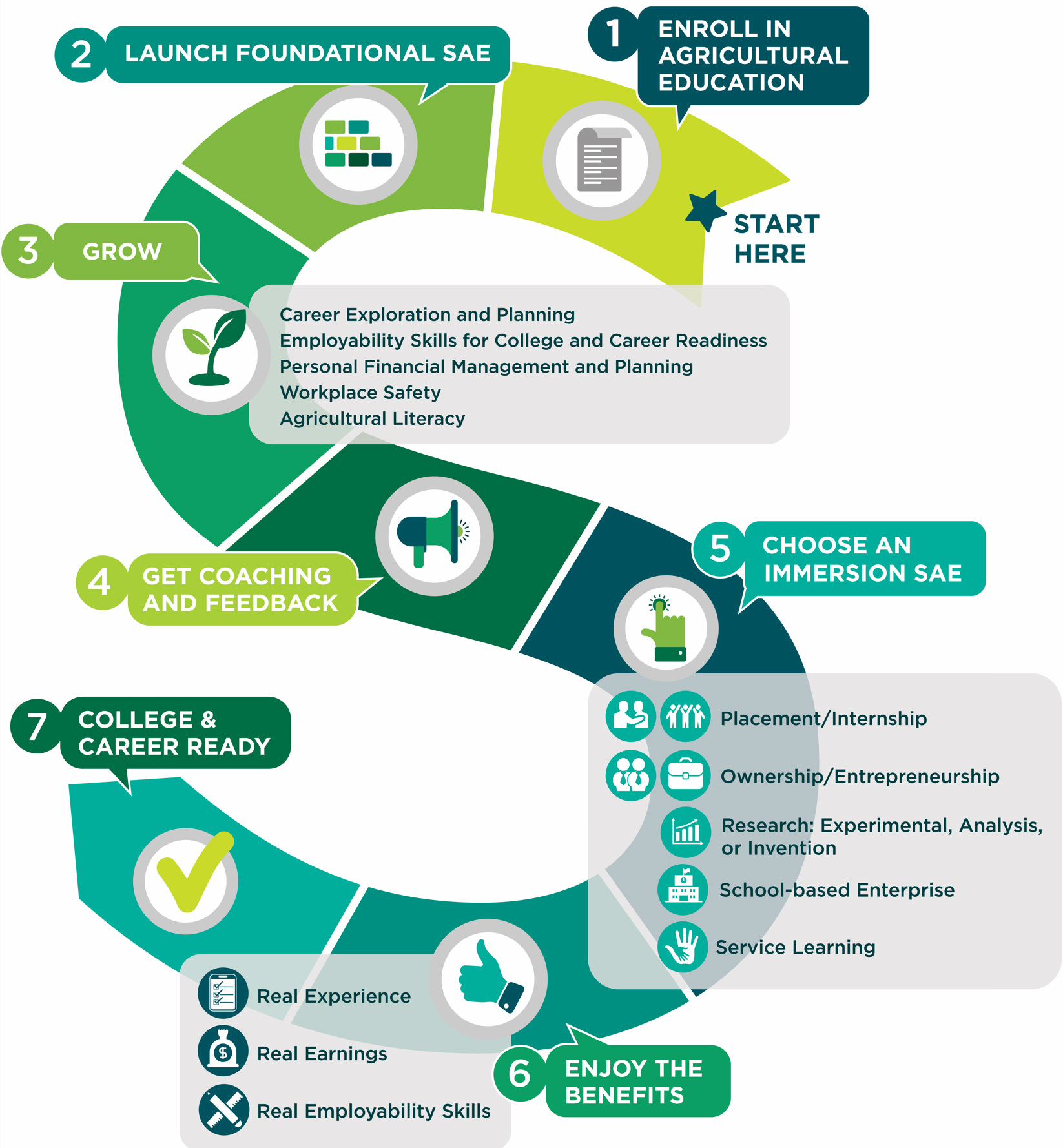
The pathway for SAE for All

Agricultural Experience (SAE) is an essential part of student success in my agricultural program. I have students working on a large range of projects that are helping them connect agriculture content and essential workplace skills. Some students are conducting research using the wet/dry lab, animal rooms and greenhouse, some students are working at home or with a business with animals or plants and some are looking to start their own business.

SAEs are student lead and teacher managed project that helps connect my class to possible careers. Since several of my students have their projects at school, I give them one day a week to work on their projects. While the students are working, I walk around and meet with them one on one.

How does my class look on SAE Fridays?
On Fridays I split the class by doing a review of what we talked about this week, usually a Kahoot! or Gimkit, and then we break out to work on SAE projects. My students really value the time they have to work with their projects. I allow students to work in any part of the agriculture department. As they are working I filter through the rooms and meet with students individually.

The Meeting
As students are working I go around and meet one on one with them. I am mainly seeing where they are at in terms or research or progress since the last time and how I can help.

This looks different for each student. I have 3 students tearing down small gas engines. For these students I might spend some time helping them ID parts and function of those parts. For some students doing research in the lab I might see what materials they need from me and what their procedure is. I have several students still exploring a topic they want to dive into with agriculture so, I might ask them what they read this week and how it relates to their career goals.

Image result for SAE ag ed
The 3-Circle Model of Agricultural Education
Keeping students on task
Everyone is at a different stage of their project. Some research is on hold while others are in their prime of their experiment. It is important to keep everyone engaged during this time we are working on SAE.

I currently have a class assignment where students are reading a scientific journal of their choosing and summarizing the methods and results from that research. Ideally this article would connect to their SAE. If they are at a pause in their research then I allow them to work on the journal for this week.
 I also want to start incorporating some ideas of the SAE for All guide in the foundational SAE stages that I saw while at the NAAE Conference. This included having students do mock interviews, apply for jobs and work on resume/cover letters.

My SAE Vision
SAE is an essential part of agriculture education. I use this piece to have students learn valuable skills needed for the workplace. They keep records that are graded on the Agriculture Experience Tracker (AET) website. They have written a report on their project as part of a professional skills unit to show how what they are doing can connect to a possible career. I see SAE as a way for me to connect students to the world outside of the walls of my agriculture department although most of the research and projects occur in my agricultural department.

I have found that I can be very hands off with students and their projects. If I let them become curious, they amaze me. The students come up with amazing ideas for their project and it is important for me to show them how they can achieve that goal. Not every project idea is possible but, if they can think of it then I want to see how we can get as close to their idea as possible.


Thursday, March 5, 2020

Week 9: Building the Village

The common phrase I hear as a parent is, "it takes a village to raise a child." This statement is one of the only phrases that actually makes sense to me when raising kids. My step daughter is lucky to have 4 parents who love her plus all of our family in her village to help her be successful.

In a school it takes several teacher and departments to come together for the students to be successful. This week I got to see this idea laid out in my building and class perfectly!
What did I teach?
Mini THON '20
 Introduction to Agriculture: This week we wrapped up plant science and moved into the agronomy unit. So far we have looked at what agronomy is, what crops are grown in the North East and what sustainable agriculture is using Journey 2050.


Current Topics in Agriculture: This week we continued our vet science unit by looking at medications, meeting our new pigs and having an artificial insemination demo/practice from a local company, Select Sires.

Mini THON
Being involved in clubs/organizations at the High School I teach at is important to me and to my students. I decided to be a chaperon for the Conrad Weiser Mini THON. I spent from 12 am to 6 am on my feet with several students in my classes. I played volleyball, colored pictures, played corn hole and kept several tired freshman awake till the end. Our school raised over $26,000 for Penn State's THON.

What did I learn?
It takes a village: Teachers cannot be separated into departments in the building. We are all seeing the same students so, we need to work together to enhance their experience in school.

What do I mean by this? I mean is that the students in my class do not only take agriculture. They take science, math and english classes too so, I need to connect with those teachers to get to know the students better/build a support system for the students.

For me, I did this through going to Mini THON and as a group we rallied around the students when they were tired and sore.

Suturing bananas in Current Topics
Incorporate others into your program: My program is not the 7 rooms of my agriculture department at Conrad Weiser. My program includes other departments in and out of the school.

The cafeteria staff is saving food scraps for my two agriculture teaching assistants to feed to the pigs. This gave me a great outlet to talk about food waste in our country, pig nutrition and solved the issue of buying pig feed. When we went to the elementary schools for FFA Week we brought students from the photograph and film classes with us to get hands on
experience recording an event.

We all need to work together to find outlets for our students to connect their passions in the building to other things going on. The students who came with us to the elementary school were not students in my class currently but, students Mr.Serfass thought should have the opportunity to gets hands on experience with their passion of videography. We became their client and they were filming for our event. We ended up getting a promotional video and they got practice working for a client.

Pairing with local businesses: I am not an expert by any means in all things agriculture. That would be impossible. It is important to know when you should step back and invite someone into your class to assist you in teaching something. I invited a representative from Select Sires into my class to demonstrate (and allow students to perform) artificial insemination on a dairy reproduction track. The students were engaged, asking questions about careers and gained so much more than I could have given them. Finding these opportunities increases the quality of my class from time to time.

Goals for next week?
1. Increase student engagement- This week I will be using popsicle sticks to choose students to answer questions. I feel at times I am always calling on the same students and hope if I start randomly selecting students it will increase participation at times.

2. Create stronger interest approaches- Sometimes my interest approaches are not as catching as I would like. I have looked for some resources to help assist me with this!

Questions:
Artificial Insemination with Select Sires
1. How are some way you alert students they are in jeopardy of failing the marking period that will motivate them to either do better next time or submit missing assignments?

2. How do you hold students accountable for their FFA CDE team practices?
I know our students have a ton going on and are split in several different places but, I am struggling to have students attend a practice for a contest that is a week and a half away.

3. How do you set up your lessons for a whole week you will be out? What do you have them working on? Is this a good place for a unit project/FFA exploration?

I am at a point where I have written sub plans several times now, but never for a whole week. My self and Mr.Serfass will be out for 3 days in the upcoming weeks. The only 2 days he will be there has a half day schedule so, we won't be even seeing all the classes.

Friday, February 28, 2020

Week 8: Lions, and Tigers, and Bears Oh My!

When Dorthy from The Wizard of OZ started walking down the yellow brick road she had no idea about the adventure she would have along the way. She encountered new people, went to a new place, and made discoveries about herself and others along the way.

In a way week 8 has been a similar experience for me! I was able to go on adventures with my students for FFA week, meet other teachers/ members of the agricultural industry and learn about myself/ my classes along the way. 

What did I teach this week?
Introduction to Agriculture: This week I tried out using Nearpod and Pear Deck to help engage students in my lectures. I found that my students really enjoyed Nearpod when doing parts of a cell. It helped engage them into the lesson and keep a "dry" subject interesting.

Guinea Pig autopsy with Current Topics in Ag
Current Topics in Agriculture: This week we had some sick Guinea pigs and one had passed. I used this as an opportunity to teach how to do a vet check/physical exam on the 2 still alive and how to preform an autopsy on the one that passed. We followed up the week by learning about using blood to spot illness and how to preform injections.

National FFA Week
This week was National FFA. Week which meant early mornings and late nights! We started this week off by attending a Reading Royals Hockey game and finished with a FFA Breakfast Friday. In between was filled with trips to the elementary school to educate them on the dairy industry and LDEs.

What did I learn?
Stand back and let the kids learn: This week I really tried to be hands off and let the students learn by doing and researching. I used the problem solving approach three different times this week and I struggled to sit back and let them take charge but, it was needed.

It is okay to change your plans to better the students: I changed my week to fit the needs of the students or the block. I changed the day we had the incident with the guinea pigs to provide a real life skill for the students. I adapted the week to help students with their LDEs or CDEs to allow for some class time to discuss these topics or to have time to teach these aspects. It was great to see the students engaging in content that they cared about.

FFA Week takes a ton of planning. This week ideally is planned by officers or at least I had thought so when I was in FFA but, it takes a ton of work on the teachers side. Sometimes it is hard to meet as an officer team so, I might have to pick the theme of what we teach to the elementary school or create ideas for the menu for the breakfast. I am the one who has tried things. I can give the officers options and ideas without picking it for them but, providing that guidance is important.

     Goals for next week
Teaching injections to Current Topics
I want to really focus on balancing that home/work life: Currently I go to school, come home and do work and then go to bed. My weekends revolve around school as well.

Think Time: I need to give more time for students to process my question before accepting an answer

Dealing with disruptive students in a class: How to properly discipline students in real time instead of after the fact. I cannot be afraid to have what we call the "Dutch Uncle" talk with them.


Questions?
1. How do you balance your home and work life?
2. How do you let students work on things but, check in on them without letting them feel like you are right next to them? I want to give my students time to process and attempt projects and activities but, sometimes feel like I am too much over their shoulder.
3. What system do you have for students who are not submitting work? What is your grading policy?


Friday, February 21, 2020

Week 7: Jack of All Trades and a Master of One

This week was not a typical week at Conrad Weiser High School. Monday we had off, Tuesday I was visiting a peer of mine which left me Wednesday- Friday with my students.

Demonstrating bandaging to Current Topics in Agriculture
What did I teach?
Introduction to Agriculture: I had students working on a design a fertilizer project with Mr.Serfass on Tuesday while I was out. Wednesday and Thursday we spent working in the lab and greenhouse. Friday was SAE (Supervised Agricultural Experience) Friday!

Current Topics in Agriculture: I had students working on a domestication project on Tuesday. On Wednesday we did a lab revolving around natural selection and Thursday-Friday we started the vet science unit.

Online Horse Evaluation Course: I have officially started an online horse judging class(New for Weiser) through ICEV. This class currently has 4 students in it and we are starting with basics of the equine industry!


What did I learn?
 This week was an eye opener to me. Up until now I worked with students in one main topic area, plant science. I sprinkled some animal science and professional skills into the mix but, this week I felt like I really had to become a jack of all trades.

Natural Selection Lab
Thursday I was in the wet lab doing fruit dissections with blocks 2 and 4. Block 3 I was in the classroom and animal lab working with vet science. Today in class for SAE Friday I was helping a student with his engine one minute, assisting with an animal behavior project the next and working with a student on a children's book for students about agriculture. Mix this all together with preparing to go to East and West Elementary Schools to teach about the dairy industry next week for National FFA Week, I was trying to become an expert in all these areas at once.

What I ultimately got out of this experience is I cannot help every student at once. I was very lucky to have Mr.Serfass to assist and troubleshoot questions to but, he will not always be here. So I am putting thoughts into how to improve this for the future. Part of this will come with practice. I will learn to allow students to look up information or write down questions without feeling the need to have an answer for them right now. Some of these questions will also be answered as I get my feet wet into different content areas of agriculture.

Goals for next week?
Next week is National FFA Week! I want to share my passion for FFA with the students in my class. We always talk about "opportunities" in FFA but, never give them the experience to want to learn more about those opportunities. I know in my block 4 class I have several students interested in animal nutrition. Maybe this is me putting together a lesson around the livestock judging CDE and having them experience a part of the contest. We do this with the middle schoolers and it has a huge success! I really want to find a way to connect the members in the chapter to FFA outside of the 4 walls of Weiser.

Questions I have?
Students working on their research for SAE Friday
What does your chapter do for National FFA Week? Do you use a class period to do any fun FFA activities?

How do you filter students to find answers on their own or at least help them become a bit independent with their SAE? I want to be there to answer questions as needed but, give them the space to sink a little to have to find the information for their projects.

When it comes to lab safety how do you have eyes on all your students at once? I plan to be more hands on in the lab in the coming weeks but, I cannot be everywhere at once!


Tuesday, February 18, 2020

The Next County Over: Visiting Mr.Kerstetter

Mr.Kersetter teaching welding
What is a better way to start off the week than going to visit a fellow colleague of mine! I left my school and students in Berks County for the day to check out what Mr.Kerstetter does at Solanco High School in Lancaster,Pa.

Setting the stage...
While at Solanco I got to observe Mr.Kerstetter teach agricultural mechanics through a power technology class, a welding class and a hand and power tools class. These courses are very opposite from my courses at Weiser but, that was not the only difference. His classes are 42 minutes instead of the 80 minutes that I am use to and enjoy!

What did I learn? 
The Grade and Ungraded Welding box with task sheet.

  • I loved the way the welding beads were graded in the welding class. Students did welds off a task sheet. Once completed the students put them in a tool box on the ungraded side for Mr.Kerstetter to grade. This is a great way to have students to have a routine in the shop as well as work at their own pace. 
  • Mr.Kerstetter allows students to retake tests and quizzes. WHY- So students can be successful and learn from mistakes. 
  • When cleaning the shop Mr.Kerstetter has a shop cleaning assignment/rotation. Each student is assigned to a specific job in the shop for clean up and then they are graded on how well they completed that task. I was struggling with clean up routines at my program but, I can see this working nicely in the greenhouse.  
  • Kahoot!- Mr.Kerstetter used a Kahoot! to introduce himself to his students. I loved this idea and the students enjoyed this too!
At the end of the day...
Power Technology Class doing engine rebuilds
Mr.Kerstetter has a great relationship with his students that shows he has set up routines that work for him and his kids. He knows their interests and preferred learning styles which he keeps in mind when designing his lesson. I am excited to see how Mr.Kerstetter continues to grow as an educator in the next 10 weeks.

Saturday, February 15, 2020

Week 6: The Student Teacher from F Wing

With a school population of 930 it is important to get to know not only the student that sits in your class day after day but, the rest of the community too. This week my goal was to try and connect with the students in my room outside of their lives in my class.

How did my week go?
This week I really got to know a few of my students. I asked them for their input on not only how they learn best but, for what they are interested in. In both my Introduction to Agriculture classes I met with each student to discuss their Supervised Agricultural Experience project (SAE). As I met with students I learned that several of my students were continuing research from high school/Middle School. Having them share their passions was very valuable to me as I start to design more lessons for the class. This also gives me more talking points with them.

Creating a list of technology students enjoy using
I also made it a point to ask students what technology helps them prepare better for assessments. I got a ton of good feedback and some new tech sites to try out because of this. With the upperclassmen I asked them what kind of assessments they would want to do. I had a good conversation with them about their opinions on projects and exams. I plan to take all this information and adapt it to my lessons as I feel fit. Student input is important to me as a student teacher. I want to know what they enjoy or despise. Knowing this information can help me become a better
educator for them.

I also decided to attend the Girls Bowling Tournament for the County Bowling Finals. I had 2 students on this team. Not only was I able to connect with these students at something they are passionate about but, I got to speak with the parents of the students. I was seen as more than the student teacher in F wing but, as a part of the community who cares about the students. I now plan to attend Mini THON in 2 weeks as well as a Reading Royals game with some students.

In my classroom...
Intro to Ag in planting radishes
This week I really stretched myself. I spent more time in the lab and greenhouse with the Intro to Ag class. I had to monitor students preforming a seed dissection while some students were already done. This gave me the time to practice keeping everyone engaged in the class although students were at different stages and different interest levels in the content. Some students spent 15-20 minutes look at the seeds under the microscope while some checked it out and were done in 5 minutes or so. I saw the same experience when we planted seeds in the greenhouse the next day. Keeping students engaged was one skill I strengthen through this week.

This week I also took a look at how I can take what another school is doing and show my students another view point. I had seen on the Ag Ed Discussion Lab a teacher post about her live stream of piglets. This was a perfect opportunity to connect what they were doing at that high school with what we could do at Weiser. I showed the video, although it had nothing to do with plant science, and got great discussion from my students. This opened up to some great ideas for what to do with our piglets that will be coming in a few weeks. I may not be teaching animal science in the Intro to Ag class but, taking what is currently going on in the industry and showing it off was a great way to show the students that "You are only limited by their lack of imagination" as Mr.Serfass would say.

Questions I still have...
1. How often do you do SAE check ins with your students?
2. What are some pro tips on integrating technology? (I need to do better at this)